
(727) 526-1294


How Much of Senior Care Would Americans Trust to AI?
Americans are already turning to AI to help care for aging loved ones, but they still want a person making the decisions that matter most.
Caring for an aging parent means learning a new vocabulary fast, from drug interactions and lab values to the fine print of a care plan. More Americans are learning it than ever. AARP and The National Alliance for Caregiving found that 63 million Americans, nearly one in four adults, provided ongoing care to a loved one with a complex medical condition or disability in the past year. That is 20 million more than in 2015. Each of these caregivers can now open a free AI chatbot in seconds, and the senior-care organizations they lean on are weighing the same technology.
To find out where families draw the line, MedBest surveyed 1,000 U.S. adults about their experience caring for people 65 and older. The survey also asked how much of that care they would trust to artificial intelligence. The questions ran from everyday help like medication reminders to the hardest call a family can face: whether an older adult can keep living alone. Respondents are already leaning on AI, yet most stop short of handing it the decisions that shape an older adult’s life. The heaviest users are also younger than most people would guess.
Key Takeaways
More than half of Americans (56%) have used AI tools like ChatGPT or Claude in the past year to help care for an older adult. Gen Z leads the shift, with 38% currently caring for someone 65 or older and 74% turning to AI for help, compared to 29% of Baby Boomers.
Respondents are most comfortable with AI handling supportive tasks like medication reminders (73%) and alerting family to a health or safety concern (70%). Only 53% are comfortable with AI assessing symptoms, the lowest of any task tested.
While 69% are comfortable with AI detecting possible falls, only 51% would trust AI monitoring to catch a fall for a loved one living independently. Respondents distrust in-home cameras (34%) and always-on microphones (32%) more than any other form of monitoring.
A majority (58%) believe AI companions could help older adults feel less lonely, but only 40% would be comfortable with their own aging loved one regularly talking to one. More than three in four (77%) say human companionship provides something AI cannot replace.
Only 5% of those surveyed would let AI choose which caregiver to hire for an aging loved one, and 80% want a human to decide whether a senior can keep living independently. If AI and a senior-care professional disagreed, just 6% would let the AI’s call stand on the grounds that it has historically been more accurate than humans.
Most Americans (75%) would choose a senior-care provider that uses AI in some way for their own future care, yet 69% would lose trust in one that used AI in care decisions without telling them or their family. Human review of important AI recommendations (52%) and the ability to opt out (50%) would do the most to build their trust.
The State of Senior Care and AI’s Involvement
Talk about AI in senior care usually sounds like a forecast, a set of questions families and providers will settle once the technology matures. In many households, caregivers stopped waiting long ago. They already open chatbots to decode a test result or prepare for a doctor’s appointment. The most active among them belong to a generation few people picture at a grandparent’s bedside.
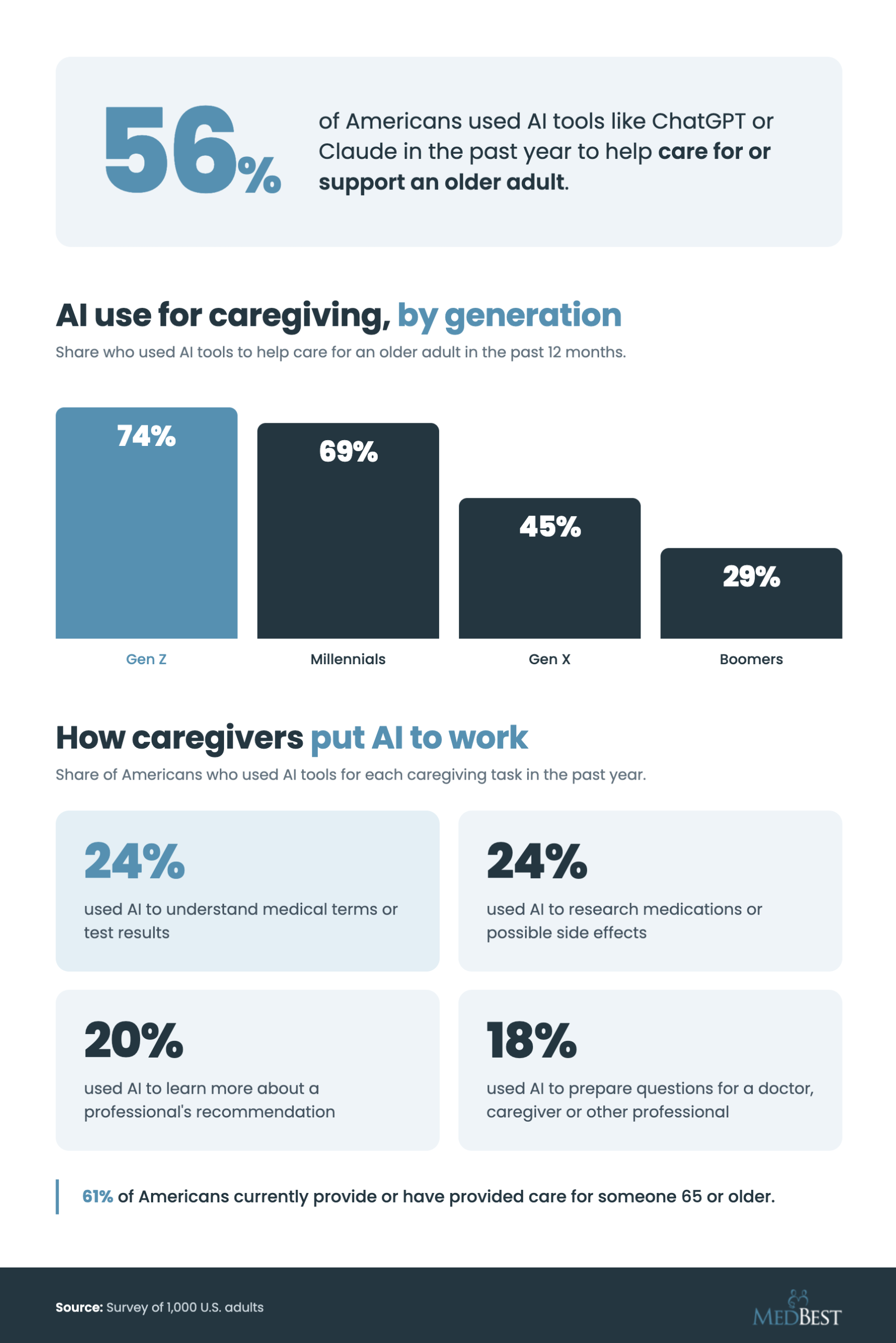
Most Americans have already become caregivers. Among those surveyed, 61% currently provide care or make care decisions for someone 65 or older or have done so in the past, and another 14% expect to step into the role within five years. Gen Z is the most likely generation to be caregiving right now (38%), ahead of millennials (34%), Gen X (32%) and Baby Boomers (17%). Some of these young caregivers likely help with grandparents. Others may live in multigenerational homes where care duties land on whoever is around.
More than half (56%) used AI tools like ChatGPT or Claude to help care for or support an older adult in the past year. Younger caregivers rely on these tools most, with 74% of Gen Z and 69% of millennials using AI for caregiving support, compared to 45% of Gen X and 29% of Baby Boomers. Men (63%) used AI for caregiving more often than women (49%). Younger adults likely carry their everyday chatbot habits into caregiving, while older adults may default to the phone call and the waiting room they already know.
Caregivers use AI chiefly as a research tool. Among respondents, 24% used it to understand medical terms or test results and another 24% to research medications or possible side effects, while 18% used it to prepare questions for a doctor, caregiver or other professional. A smaller group goes further, with 20% using AI to learn more about a professional’s recommendation and 1 in 10 (10%) using it to check or question one. Gen Z (14%) and millennials (13%) are more than three times as likely as Baby Boomers (4%) to check a professional this way, and men are nearly twice as likely as women (13% vs. 7%). Families appear to be building these habits on their own, likely before most providers have offered any guidance on how AI fits into a care plan.
Which Senior-Care Tasks Americans Will Hand Over to AI
Americans sort senior-care tasks by what a mistake would cost. They’re glad to hand AI the jobs where an error means a late reminder. They are far more cautious where an error could mean a missed diagnosis. One task near the middle of the list breaks the pattern in a way few would predict.
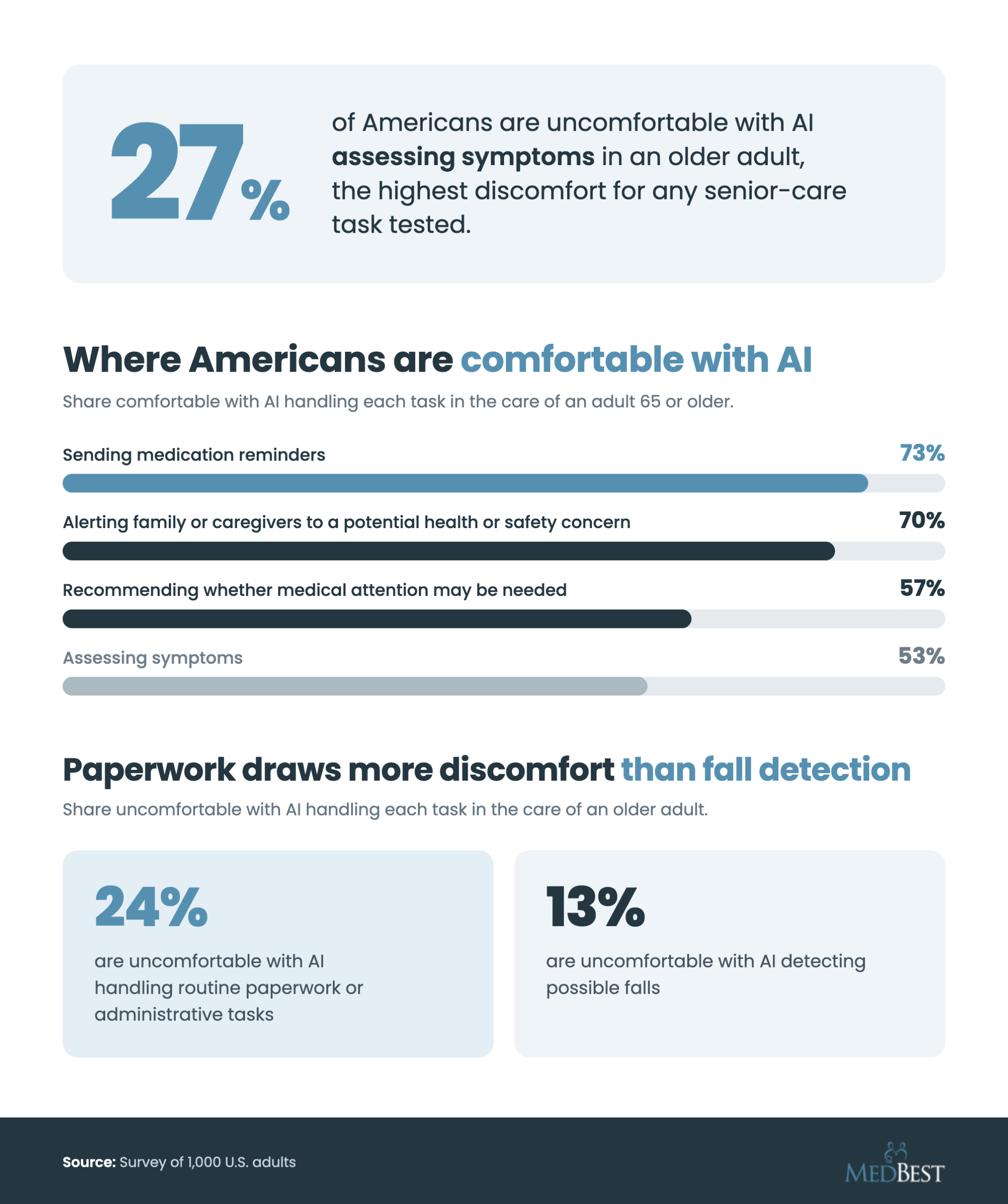
Respondents are most comfortable with AI taking on supportive work, led by sending medication reminders (73%) and alerting family members or caregivers to a potential health or safety concern (70%). Their comfort wanes as tasks move from support toward judgment. Only 57% are comfortable with AI recommending whether medical attention may be needed. Just 53% are comfortable with AI assessing symptoms, the lowest of any task tested, and 27% are uncomfortable with it, the highest discomfort for any task. Respondents likely see a symptom check as a diagnosis in everything but name, where a wrong answer carries real medical risk.
Paperwork is a surprise. More respondents are uncomfortable with AI handling routine paperwork or administrative tasks (24%) than with AI detecting possible falls (13%). Administrative files hold insurance details and medical histories, so respondents may worry less about the task itself than about where all that data ends up. Families can picture exactly what a fall detector is for, and its value in an emergency needs no explanation.
Millennials are the most comfortable generation on 10 of the 11 tasks tested, including medication reminders (77%) and assessing symptoms (64%). Many millennials are raising children while checking in on aging parents, and they may see AI as a way to win back time. Baby Boomers pull back hardest as tasks turn serious. Only 42% of Baby Boomers are comfortable with AI recommending whether medical attention is needed, compared to 63% of millennials. Respondents agree most on medication reminders, with 72% of Gen Z, 77% of millennials, 70% of Gen X and 71% of Baby Boomers comfortable with the task, along with 73% of men and women alike. The genders split on the higher-stakes tasks. Men are more comfortable than women with AI screening caregivers (66% vs 50%) and assessing symptoms (59% vs. 48%).
AI Monitoring Inside a Loved One’s Home
Approval of a technology in the abstract is easy. Trusting it to watch over your own mother, alone in her house at 2 a.m., is a harder call. Families weighing home monitoring stand right on that line. They also face a question few settle in advance: who decides whether the sensors go in at all?
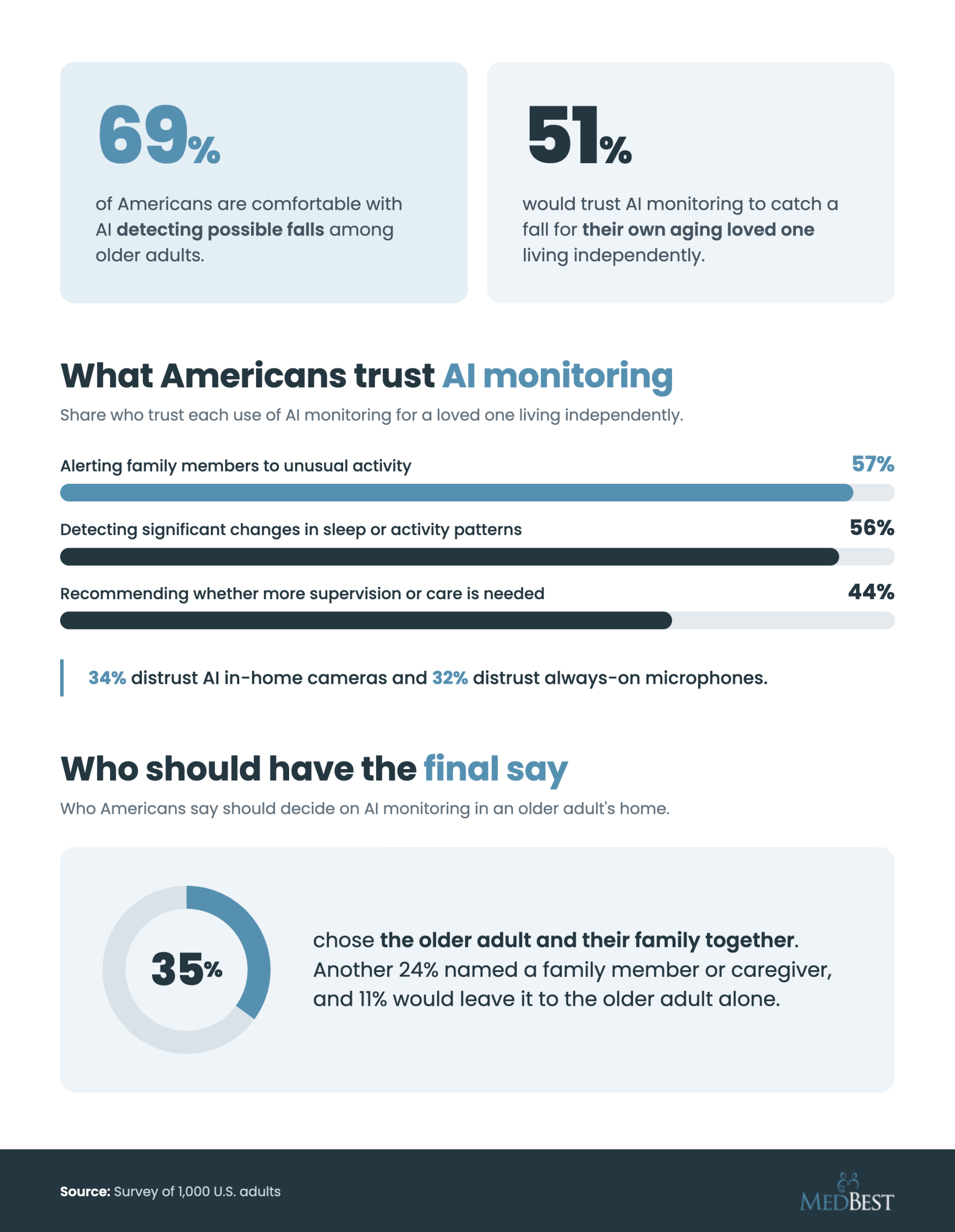
In general, 69% of Americans are comfortable with AI detecting possible falls among older adults. When the person is their own aging loved one living independently, only 51% would trust AI monitoring to catch a fall. Respondents likely hold the technology to a higher standard once a familiar face is on the line, since a single missed fall could leave someone on the floor for hours before anyone knows.
Respondents trust AI most when it keeps family informed. Among those surveyed, 57% trust AI to alert family members to unusual activity and 56% trust it to detect significant changes in sleep or activity patterns. Gen Z is especially receptive to family alerts (66%, compared with 54% to 55% of every other generation), perhaps because location sharing and group-chat updates already shape how younger families keep tabs on each other. Fewer respondents (44%) trust AI to recommend whether more supervision or care is needed, and women are far more skeptical than men (38% vs 27%).
The hardest line for any respondent is privacy: they distrust in-home cameras (34%) and always-on microphones (32%) more than any other form of monitoring. Baby Boomers are the most wary of both (43% and 40%, compared to 26% and 28% of millennials), and women distrust cameras more than men (38% vs. 29%) and microphones more than men (36% vs. 27%). Many carry that unease into who decides whether the devices go in at all. Asked who should have the final say over AI monitoring in an older adult’s home, 35% chose the older adult and their family together and 24% named a family member or caregiver, while only 11% would leave the decision to the older adult alone. Baby Boomers are the generation most likely to face the choice soon, yet just 9% would leave it to the older adult. They are also more than twice as likely as Gen Z to favor a joint family decision (48% vs. 23%), likely because they see a shared decision as a safeguard for their independence.
The AI Companion Paradox
An AI companion that remembers a child’s name and never tires of hearing the same story sounds like a gift for an older adult who spends long days alone. Families see the appeal. Far fewer want one keeping their own mom or dad company, and they’re clear about why.
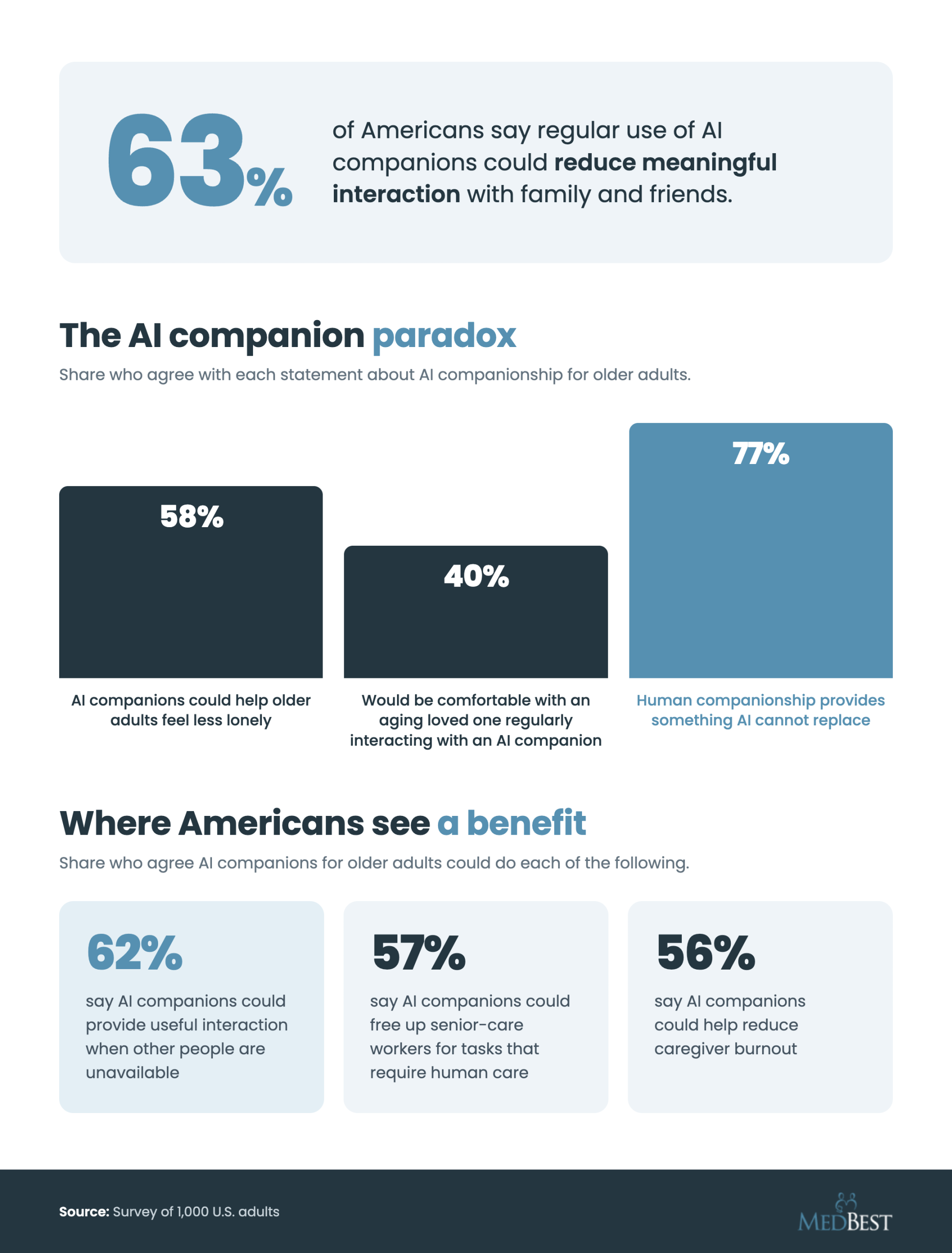
Most respondents (58%) believe AI companions could help older adults feel less lonely, and 62% say they could provide useful interaction when other people are unavailable. Respondents see a workforce benefit too. Of those surveyed, 57% agree AI companions could free up senior-care workers for tasks that require human care, and 56% say they could help reduce caregiver burnout. Yet only 40% would be comfortable with an aging loved one regularly interacting with an AI companion. Many people likely endorse the idea for someone else’s grandmother and hesitate when they picture their own.
Respondents can name exactly what worries them. Of those surveyed, 63% say regular use could reduce meaningful interaction with family and friends, and every generation shares that worry almost equally (64% of Gen Z, 63% of millennials, 65% of Gen X and 62% of Baby Boomers). Only 36% believe providers could rely on AI companionship as a substitute for human staff, though millennials (44%) are far more open to the idea than Baby Boomers (25%). Millennials are also the only generation in which a majority (51%) would be comfortable with a loved one regularly talking to an AI companion, compared with 36% of Gen Z, 38% of Gen X, and 30% of Baby Boomers.
More than three in four (77%) say human companionship provides something AI cannot replace. Older respondents hold that view most firmly, with 65% of Gen Z and 74% of millennials, 82% of Gen X, and 88% of Baby Boomers. Women feel it most deeply, with 61% strongly agreeing compared to 50% of men. For many families, the Sunday visit and the nightly phone call are the care itself, and respondents show little interest in outsourcing them.
Where Americans Let AI Make the Call
Picture an AI system with a better track record than the professionals it works beside. Most Americans still wouldn’t give it the final word on a senior’s care. As the stakes climb, from scheduling a checkup to deciding whether someone can keep living at home, they want a person accountable for the decision more firmly.
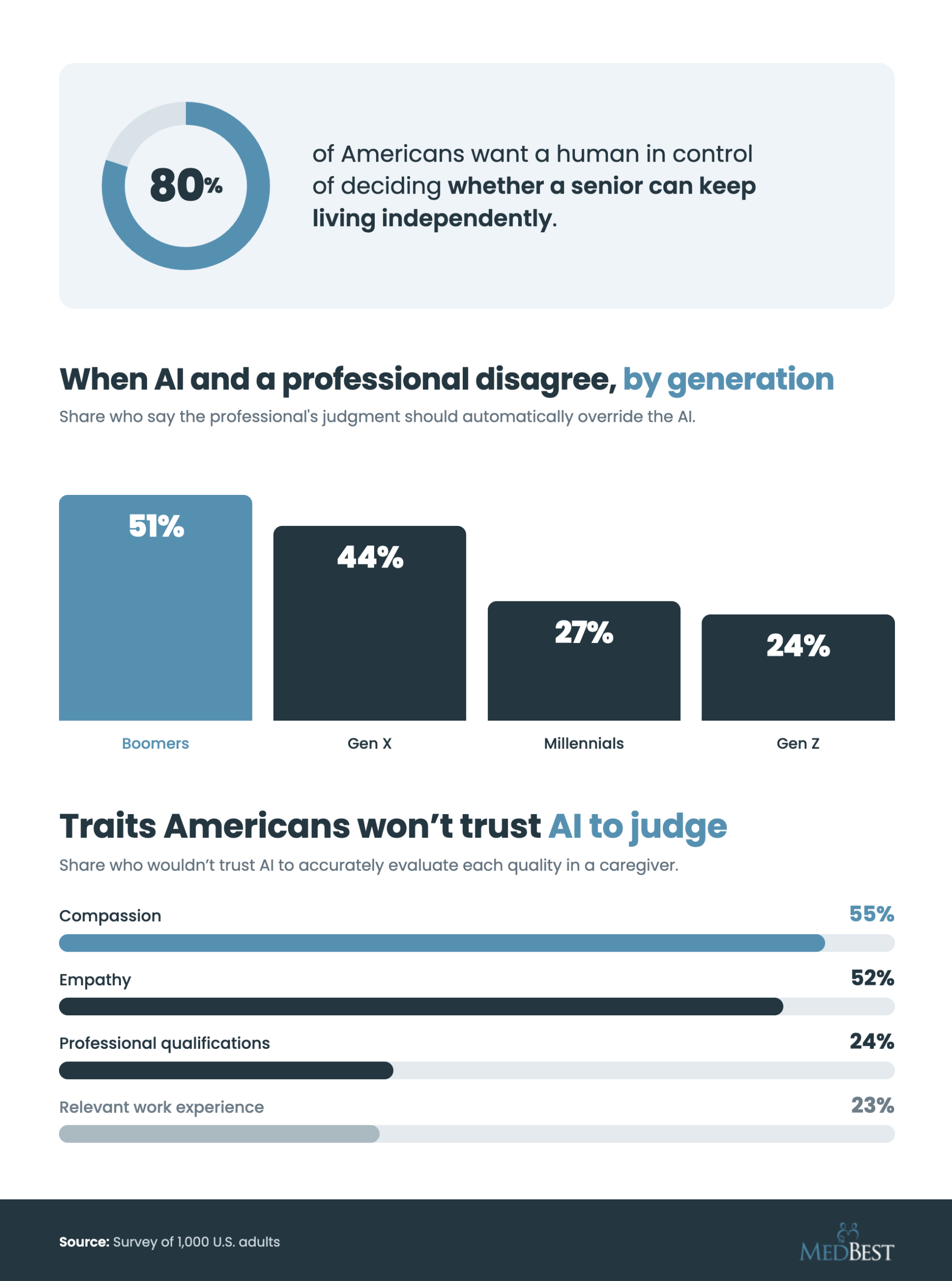
People want a human check even on routine work, and only 11% say AI scheduling appointments needs no human oversight. They grow more insistent as the stakes rise. On medical attention, 36% say a human should always make the final decision on whether a senior needs it, and 35% say the same about how much care a senior should receive. The line is drawn firmest around independent living. A full 80% want a human in control of that decision, and only 5% say it needs no human oversight, likely because the answer can mean leaving a home of decades. That 80% includes the 17% who say AI shouldn’t be used for the assessment at all, and women are nearly twice as likely as men to hold that view (22% vs 12%).
Respondents faced their sharpest test in a scenario where AI and a qualified senior-care professional disagree about how much care an older adult needs. Most (63%) say a human should settle the disagreement. They split between letting the professional’s judgment automatically override the AI and sending the AI’s recommendation to another qualified professional. Just 6% would let the AI’s call stand because the system has historically been more accurate than humans. Baby Boomers side with the professional most often, with 51% saying the professional’s judgment should automatically win, compared with 44% of Gen X, 27% of millennials and 24% of Gen Z. Many Baby Boomers have long relationships with their own doctors and likely see a professional’s judgment as something earned. Younger adults are far more willing to let the AI’s recommendation stand in some form (30% of Gen Z vs. 4% of Baby Boomers), while women (41%) are more likely than men (30%) to give the professional the automatic final word.
Most respondents applied the same instinct when choosing a caregiver. Only 5% would be comfortable letting AI choose which caregiver to hire for an aging loved one, and just 1% of Baby Boomers agree. The most popular role for AI (33%) is evaluating candidates and recommending a shortlist while a person makes the final choice. Another 19% don’t want AI involved in any stage, including 29% of Baby Boomers compared to 11% of Gen Z. Respondents doubt AI can read character. Of those surveyed, 55% wouldn’t trust it to accurately evaluate compassion and 52% say the same of empathy, compared to 24% for professional qualifications and 23% for relevant work experience. Credentials sit on a résumé, while compassion shows up in how someone treats a frightened resident in the middle of the night, which is why judging personality fit still takes a human read.
The Future of AI in Senior Care Depends on Human Leadership
Most families have made a cautious peace with AI in senior care. What they want from providers now is honesty about when it’s used and a named person who answers for its recommendations. Senior living leaders who offer both will likely earn a kind of trust no software rollout can buy.
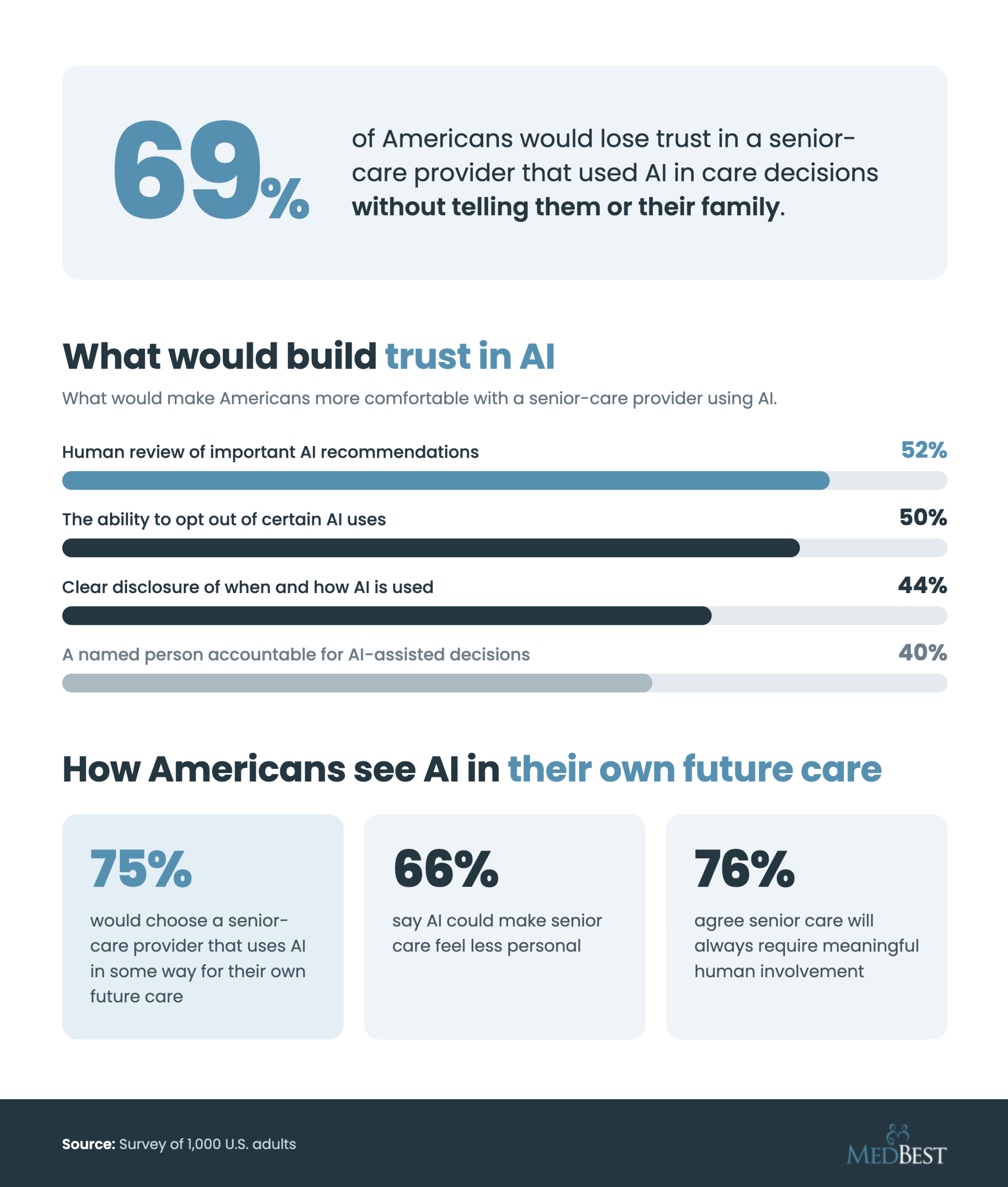
When respondents think about their own future care, 75% would choose a provider that uses AI in some way, though only 5% want one that uses AI extensively. Many see a practical upside, with 50% saying AI can help address nursing and caregiver shortages, yet 66% say it could make senior care feel less personal and only 45% believe it will improve senior care overall. Gen Z is the only generation more optimistic than worried, with 58% expecting AI to improve senior care and 55% saying it could make care feel less personal, while Baby Boomers flip that balance at 36% and 78%. Even so, 67% of Baby Boomers would prefer a provider that uses AI in some way, likely because older adults expect to encounter the technology and want it kept in a supporting role.
A majority treat transparency as a dealbreaker. Of those surveyed, 69% would lose trust in a provider that used AI in care decisions without telling them or their family, and 63% believe senior-care organizations may adopt AI faster than families are comfortable with. Baby Boomers felt this most strongly (81%, including 64% who strongly agree), compared to 72% of Gen X, 66% of Gen Z and 61% of millennials. Women are far more likely than men to strongly agree (51% vs. 35%). Many respondents likely read undisclosed AI as a breach of the trust a family extends when it hands over a parent’s care.
Respondents can also name the fixes. They say human review of important AI recommendations (52%) and the ability to opt out of certain AI uses (50%) would do the most to make them comfortable, followed by clear disclosure of when and how AI is used (44%) and a named person accountable for AI-assisted decisions (40%). In effect, families want a person behind every safeguard, which puts the burden on senior living executives who can adopt AI thoughtfully while keeping human judgment at the center of care. Looking further ahead, 76% agree senior care will always require meaningful human involvement, regardless of how advanced AI becomes.
What Families Will Expect From Senior Living Leaders Next
Family caregivers brought AI into senior care on their own, often late at night while searching for answers about a parent’s new prescription. Providers now serve families who may arrive at a care conference with a chatbot’s read already in hand. Senior living organizations need a clear, honest account of where their own tools fit beside that habit, and where those tools stop.
Families have sketched a workable map. They welcome AI on the logistics of care and want people firmly in charge of companionship and of any decision that changes where or how an older adult lives. Providers that follow that map and put a named person behind every important recommendation will likely find families far more willing to say yes.
Getting there is a leadership job. Executive directors and nursing leaders who run senior living communities will decide how AI enters daily care and how clearly their teams explain it to residents and families. Developers will keep making these tools smarter. The communities families trust most will be the ones whose leaders never let a tool stand in for a person.
Methodology
MedBest surveyed 1,000 U.S. adults through an online survey. The survey examined Americans’ experience caring for adults 65 and older, their comfort with and trust in AI across senior-care tasks, expectations for human oversight, views on AI companionship and caregiver selection, concerns, and what would make them more comfortable with providers using AI. Results were analyzed by generation (Gen Z, Millennials, Gen X, Baby Boomers) and gender. Results were post-stratified. Percentages may sum to more than 100% where respondents could select multiple answers.
About MedBest
MedBest is a national executive search firm that works exclusively in senior living. The firm places permanent and interim leaders across assisted living, skilled nursing, life plan communities, independent living and memory care. Founded in 2001 and staffed by recruiters who come from senior care themselves, the Tampa-based firm helps organizations find the executives who will guide their communities through changes like the arrival of AI while keeping residents and families at the center.
Fair Use Statement
The findings in this study may be used for noncommercial purposes only. If you share them, please credit MedBest and link back to this page as the original source of the research.
Visited 11 Times, 11 Visits today